
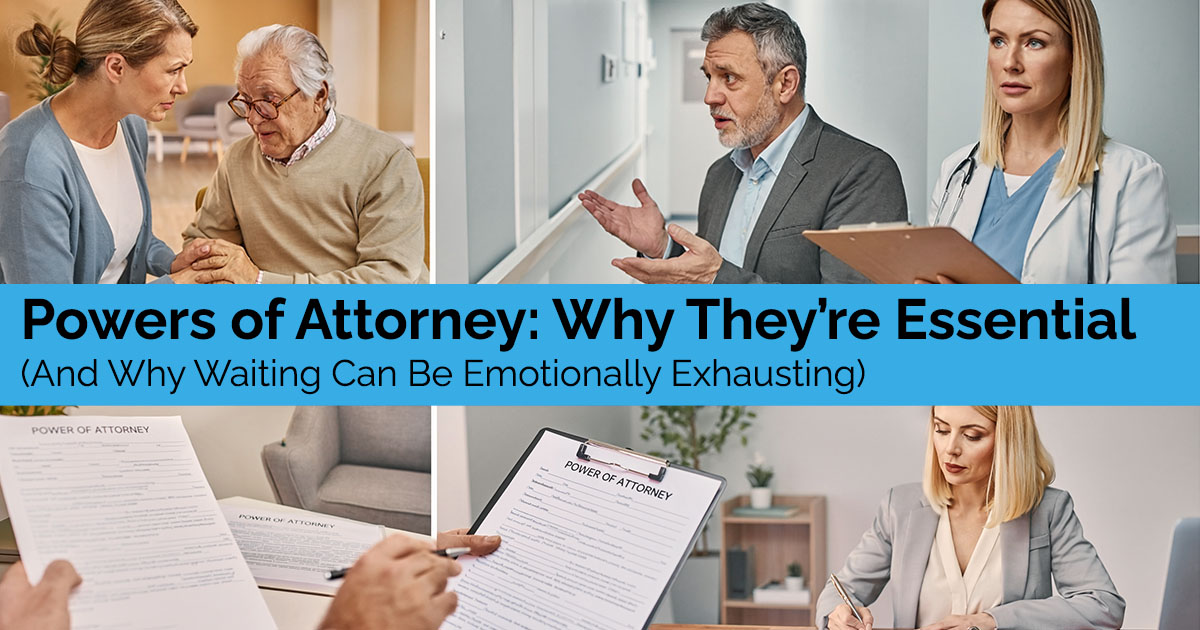
“My husband is in the hospital and I need a Power of Attorney.”
“My wife just had surgery and we need to put off signing documents.”
“My sister is in a nursing home and I need help.”
I’ve heard these words more than once in recent months.
The common thread isn’t age, wealth, or family circumstance. The common thread is timing.
The people needing help had either never given much thought to a Power of Attorney or had planned to “get around to it later.” Then something happens — a stroke, illness, surgery, dementia concerns, an accident, or simply an unexpected decline — and suddenly “later” has arrived.
As an understatement, legal documents often don’t work well on an emergency timetable.
The Problem Isn’t Just Physical Illness
When someone is in the hospital or a nursing home, people understandably assume that if they can physically sign a document, everything is fine.
Yet, signing a legal document requires more than being able to sign on a designated line.
As an attorney, I have both a legal and ethical responsibility to be comfortable saying that someone signing a document understands what they are signing and is making that decision knowingly.
Crisis situations can make this difficult.
I’ve seen circumstances where someone was completely clear and lucid one moment and confused the next. I’ve seen situations where pain medications affected awareness. I’ve seen situations where certain infections impact mental function. I’ve seen memory issues where a person could carry on a conversation for several minutes and then become disoriented, sometimes in mid-conversation.
In these situations, timing becomes unpredictable. Sometimes it becomes impossible.

A Situation That Illustrates the Problem
Recently I met with the spouse of a couple who had recently moved to Florida to become Florida residents.
The other spouse had been diagnosed with dementia. To the best of the knowledge of the spouse with whom I spoke, no physician had formally determined that the “ill” spouse lacked capacity to make decisions. I was asked to meet with the ill spouse and share what I thought.
Unfortunately, I wasn’t comfortable with the capacity of the ill spouse.
The couple had Powers of Attorney from the state where they previously lived which, at first seemed like good news. While the documents covered many general situations, they did not contain provisions needed for the circumstances now facing them in Florida.
They had a document, but not what they needed. That can be difficult to understand even in the best of circumstances.
This can almost be harder than having no document at all because people reasonably assume that with an existing document that any situation will be covered…until they discover that the person wanting to help is unexpectedly limited.
What a Durable Power of Attorney Actually Does
A Durable Power of Attorney allows one person (called the Agent) to make financial decisions for another person (called the Principal).
The word durable is important because it means the authority continues even if the individual later becomes unable to make decisions independently.
Depending on how it is written, powers may include:
- Accessing bank accounts
- Making deposits and withdrawals
- Handling real estate matters
- Managing digital assets
- Creating or modifying a revocable trust (if specifically authorized)
- Applying for government benefits such as Medicaid or VA benefits
- Handling financial matters during periods of incapacity
Some of these powers — particularly certain estate planning powers and Medicaid-related powers — must be expressly included in the document.
And that’s where problems often arise.
The Missing Powers People Never Think About
In many of the situations I’ve recently seen, the issue wasn’t simply that a Power of Attorney didn’t exist. The issue was that the existing document lacked the specific power needed at the moment. The Agent suddenly discovers they cannot take an action everyone assumed would be allowed.
Imagine trying to help your spouse or parent during a crisis and you hear: “I’m sorry — you don’t have authority to do that.”
That is a difficult conversation.
This Isn’t Just for Older Adults
Long before I opened my practice, I became aware of another reality:
- One second after midnight on the day a child turns eighteen, parents lose legal authority they previously had.
Parents may still be Mom and Dad and be able to help financially. Legally, their child has become an adult.
If an eighteen-year-old is in an accident, hospitalized, or facing an unexpected medical issue, parents often discover they no longer have automatic authority to help with financial and legal matters.
Tragedies don’t respect age.
Married People Need Powers of Attorney Too
I often hear this:
“But we’re married.”
Many spouses assume marriage automatically gives them authority to handle financial decisions for one another. In many situations, it doesn’t – consider a couple who keeps separate checking/savings account.
Marriage does not automatically allow a spouse to sign documents, access accounts, complete certain transactions, or take actions that require legal authority.
And when those assumptions meet real life — during illness, incapacity, or crisis — families can find themselves facing unnecessary obstacles at exactly the wrong time.
The Best Time Is Before You Need It
Estate planning often asks us to consider possibilities we’d rather avoid thinking about: accidents, illness, strokes, surgery, or cognitive decline.
Most people don’t avoid Powers of Attorney because they’re careless. They avoid them because they don’t expect life to change quickly.
Many of the difficult calls I receive begin with the same realization:
“We thought we had more time.”
The best Power of Attorney is the one signed long before anyone needs it — giving the people who love you, and the people you love, the ability to help when life becomes unexpectedly hard.